Florida Venomous Snake Guide
Florida is home to a variety of snake species, including several venomous ones. This guide provides essential information to help you identify potentially dangerous snakes, understand their behavior, and learn how to stay safe during outdoor activities. We'll cover key characteristics of venomous snakes like rattlesnakes, coral snakes, and cottonmouths, as well as safety tips to minimize the risk of encounters and what to do in case of a snakebite. If you find a venomous snake on your property, don't approach it. Our team handles snake removal in Central Florida and will remove it safely, and most of those calls come from inside the metro, where snake removal in Orlando runs heaviest through the warm months around the chain-of-lakes neighborhoods and pool cages. Download the free guide below for detailed information and helpful images. Identification is only the first half of the question; the second is what to do once you know what you are looking at, and how we handle snake calls across Central Florida covers the removal side, the species that turn up most, and the Florida rules on which snakes may lawfully be moved at all.
How can you tell if a Florida snake is venomous?
Five of Florida's six venomous snakes are pit vipers: the eastern diamondback, timber and dusky pygmy rattlesnakes, the cottonmouth and the copperhead. Each has a deep heat-sensing pit between the eye and the nostril, a vertical cat-like pupil and a heavy body. The sixth, the eastern coral snake, has round pupils and is known by its colored bands.
UF/IFAS warns against leaning on those features, because you can't see them without getting close, and getting close is the thing to avoid. A triangular head doesn't prove a snake is venomous either: some harmless species flatten their heads and flare their jaws when threatened. FWC also says most snakes people run into are nonvenomous. If you can't name it from where you're standing, leave it alone and keep your distance.
| Snake | What to look for | Where it lives | In Central Florida? |
|---|---|---|---|
| Eastern diamondback rattlesnake | Dark diamonds with cream borders, broad head, 3 to 6 ft | Pinelands, scrub, flatwoods, fields | Yes, every county |
| Dusky pygmy rattlesnake | Gray with dark blotches, tiny rattle, under 20 in. | Flatwoods, scrub, sometimes yards | Yes, every county |
| Cottonmouth | Dark body, stripe through the eye, white mouth lining | Edges of lakes, ponds and ditches | Yes, every county |
| Eastern coral snake | Red bands touching yellow, black snout | Leaf litter, logs, brush piles | Yes, statewide except the Keys |
| Timber (canebrake) rattlesnake | Reddish stripe down the back, black tail | Moist pinelands, river bottoms | Rarely; mostly north of Gainesville |
| Southern copperhead | Hourglass-shaped bands, copper-colored head | Near streams in the Panhandle | No |
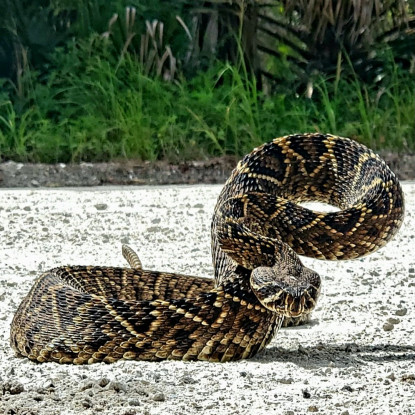
How do I identify an eastern diamondback rattlesnake?
The eastern diamondback is the largest venomous snake in the United States. Look for a row of dark diamonds with brown centers and cream borders down the back, a big, broad head, and a dark stripe edged in white running back from each eye. Adults usually measure three to six feet, and the scales look rough.
FWC records it in every county in Florida, so this is very much a Central Florida snake. It likes dry ground. UF/IFAS lists pinelands, scrub and golf courses, and FWC adds palmetto flatlands, old fields and brushy or grassy lots. It hides in gopher tortoise burrows, armadillo holes and stump holes. Don't count on a warning, either: UF/IFAS notes that some diamondbacks don't rattle even when they're ready to strike, and FWC says a coiled one can reach up to two-thirds of its body length.
How do I identify a dusky pygmy rattlesnake?
The dusky pygmy rattlesnake is Florida's smallest venomous snake; adults rarely top 20 inches. It's gray with rounded dark blotches, a row of darker blotches down the middle of the back with reddish-brown marks between them, and a dark band from the eye to the jaw. Its tiny rattle buzzes like an insect.
FWC finds it in every county. UF/IFAS places it across the state except the Keys, in pine flatwoods, oak scrub, open pinelands and palm hammocks, and sometimes in residential neighborhoods. It tends to stand its ground rather than slip away, bobbing its head and striking when bothered, so a small one in a flower bed still needs plenty of room.
How do I identify a cottonmouth (water moccasin)?
A cottonmouth is a thick-bodied pit viper with no rattle. Adults are olive-brown to black, sometimes with faint crossbands and sometimes plain, with a dark stripe through the eye. Young ones are tan or reddish-brown with darker crossbands and a bright yellow tail tip. Most Florida adults are about three feet long, though some pass five.
FWC says it lives in every county. Around Central Florida homes that means the edges of lakes, streams, marshes, retention ponds and roadside ditches, although it can wander a good way from water. When cornered it often opens its mouth wide to show the white lining that gives it the name.
Harmless look-alikes: nonvenomous water snakes, which are more common. FWC's test is the eyes. A water snake has round pupils, no facial pit, and eyes you can see from directly above. On a cottonmouth, an overhanging brow ridge hides the eyes from above. Young cottonmouths also get mistaken for copperheads. Give water snakes space too: UF/IFAS notes they're quick to bite even though they aren't venomous.
How do I identify an eastern coral snake?
Look for a slender snake banded in red, yellow and black, with a blunt black snout and a yellow band just behind it. Most are under two feet long. The bands are the giveaway: if red touches yellow, it's a coral snake. UF/IFAS teaches it as "yellow, red, STOP," and the round pupils don't mean it's safe.
UF/IFAS puts the coral snake across all of Florida except the Keys. It spends much of its life underground or under cover, and FWC lists pine woods, pond and lake edges, hammocks, rotting logs, deep leaf litter and old brush piles. It's shy and seldom aggressive unless startled or hurt. According to FWC, most coral snake bites happen when someone picks up what looks like a pretty little snake.
Harmless look-alikes: the scarlet kingsnake and the scarlet snake. On both, the red bands touch black rather than yellow, and the snout is pointed and red instead of black. UF/IFAS adds that the color rule only holds for coral snakes in North America.
How do I identify a timber (canebrake) rattlesnake?
The timber rattlesnake, known in Florida as the canebrake rattlesnake, is pinkish-gray to tan, with irregular dark bands, a reddish-brown stripe down the middle of the back, and a dark brown or black tail that ends in a large rattle. It has a dark band across the face, rough scales, and can reach five feet or more.
You're unlikely to meet one in Central Florida. UF/IFAS places it in northern Florida south to about Gainesville, with a few sightings farther south, and FWC's guide gives Alachua County as the southern limit of reports. It lives in moist pinelands, river bottoms and hammocks.
Do copperheads live in Central Florida?
No. In Florida the southern copperhead lives only in a small area west of Tallahassee, mainly along the Apalachicola River, and in a few of the westernmost Panhandle counties. It's light brown, gray or pinkish tan, with darker bands that are wide on the sides and narrow on the back, giving them an hourglass shape. Most are under three feet.
FWC notes that many snakes reported as copperheads turn out to be young cottonmouths, which have the same banded look. In Central Florida, outside the copperhead's range, a banded snake with a yellow tail tip is worth treating as a possible young cottonmouth.
What should I do if I find a venomous snake in my yard?
Step back and let it be. FWC's advice is to stand back and watch, because a snake that isn't cornered will usually leave. Keep children and pets well away, and don't try to kill, catch or move it. FWC says there's no good reason to kill a snake unless a venomous one poses an immediate danger to people or pets.
If it won't leave, gets into the house or garage, or keeps turning up in the same spot, that's when to call us. Emergency wildlife removal covers venomous snakes, and you can request a free estimate for a property that sees them often. FWC also points out that regular snake sightings near a house can mean rodents. Clearing brush, lumber and debris piles, and cleaning up spilled birdseed and pet food, takes away both the cover and the prey. Outdoors, watch where you step, keep dogs on a short leash in snake habitat, and take care around stumps, burrows and fallen trees.
What should you do if a venomous snake bites someone?
Call 911 right away, then Poison Control at 1-800-222-1222. The UF/IFAS snakebite action plan says to move the person away from the snake, keep a bitten arm or leg still and below heart level, take off rings, watches and tight clothing near the bite, and wash the bite with soap and water.
Don't wait for symptoms to show. Skip the tourniquet, ice, cutting and suction, and don't try to catch the snake. Doctors don't need it identified to treat the bite. Write down the time of the bite and any symptoms instead, and hand that to the paramedics.
Printable venomous snake guide (PDF)
Sources: Florida Fish and Wildlife Conservation Commission, Living with Snakes, the cottonmouth and eastern diamondback rattlesnake species profiles, and Florida's Venomous Snakes (PDF); UF/IFAS Extension, Recognizing Florida's Venomous Snakes and Emergency Snakebite Action Plan.